Friday, 17 March 2017

Savaging the West; The necessity of Giant-monster flicks

Can Kong: Skull Island revitalise a much needed genre?


I have a strange fascination with giant-monster flicks. Usually one to shy away from the likes of most big-budget CGI-laden blockbusters, I find that there's something inherently interesting in the mythos of big-monster cinema. Not that I would be in a hurry to see them, though, I'm interested more in their cultural value than in their cinematic merits. When Peter Jackson's 2005 remake of King Kong came out, it remained a favourite of mine for a surprisingly long time growing up. And then, when the Godzilla remake came out in 2014, I felt obscurely compelled to go and see it. It wasn't that great. But, it didn't spoil my interest in the genre. And with the recently released Kong: Skull Island (2017), I once again feel the urge to invest time and attention into a film which might not even be that great. Incidentally, I have yet to see the two biggest breakout hits of the genre; Monsters (2010) and Cloverfield (2008). None of these films might ever linger in my memory (Aside from Pacific Rim (2013), which got it completely right), but I think that the giant-monster genre has an important role to play in the current political climate.

The giant-monster usually works as a metaphor for human destruction; the original Godzilla was the atomic bomb, the 2014 edition drew parallels to 9/11 and, more recently, the setting of the latest King Kong is a take on the Vietnam war. But, really, the metaphors run a lot deeper than that. They aren't just about direct human destruction, but folly and ambition, causing indirect harm. And, a lot more significantly, they aren't just about the ways in which man can hurt man, but the relationship between man and the natural world. In the same way that Superhero films explore otherness by amplifying and caricaturing it to Hollywood levels of fun, the giant-monster film examines the spectacle of human destruction via ecological exploitation. As we see in the original King Kong (1933), the beast is integrated into the tribe's way of life, they know of its power and offer Ann sacrificially in order to please it. But when Kong is captured, exported to the States and exhibited for money, he breaks free and causes havoc across New York. Nevermind that he is eventually shot down and killed, he has still wrought a massive amount of destruction upon Western society.

Humankind's immoral exploitation of nature, driven by capitalism and colonial tendencies, will ultimately result in its own destruction. This swatting down of humankind, though, is not to discredit it. It is wrong to nihilistically think of humans as a cancer on Earth, as some environmentalists do. Rather, the giant-monster film today dissects the ethics of neoliberalism and foreign intervention (or lack thereof). Undoubtedly we live in a globalised, market-driven world, but this does not have to be incompatible with ecological protection. In giant-monster films, man is only attacked when he has done something to provoke nature. It is for this reason that these films should matter today, to highlight the wrongdoings of the Western world. Kong is a great uncivilising force, reminding us that we are not omnipotent on this planet. In an age of Google Earth and Wikipedia where every inch of the globe is available for public scrutiny, the mysterious giant-monster lurks undetected. And with a U.S president not just apathetic to but actively opposed to environmental protection, the genre now has a more profound urgency. It's a shame to see monster films dominated by the genteel b-movie industry, endlessly churning out harmless titles like Sharknado (2013) and Sharknado 2: The Second One (2014), softening the genre. Kong: Skull Island seems to have its b-movie sensibilities and flourishes, but hopefully it can transcend those aesthetic boundaries to deliver something a lot more complex, and a lot more timely.

Monday, 6 March 2017

The Inexplicable and eerie English ghost

Supernatural International


Image result for whistle and i'll come to you

Recently I have briefly examined one quirk of American supernatural Horror films; the Poltergeist. A vengeful, confrontational and often violent paranormal manifestation, the Poltergeist is a perfect receptacle for both the American obsession with good and evil moral narratives, and Hollywood's need for constant on-screen spectacle and excitement. However, this cannot be simply boiled down into an analysis of whats good and whats bad in Horror. There was plenty to admire in the films I looked at in the previous post, Poltergeist (1982) and Paranormal Activity (2007). They were both innovative in their own ways and, as a result, very entertaining at times. Yet, it wasn't so much the films themselves that were at fault as much as the culture they fed.

Unlike some more strictly art-house films, a lot of Horror cannot be viewed entirely outside of its cultural context. As a form of popular culture, it corresponds closely to social or political circumstances, including the appetites of the public. This is what makes Horror so interesting as a genre, it reflects the dynamic between people and institutions. The brief success of the Paranormal Activity series is a prime example of this, illustrating a clear logic of supply and demand. Just as the effects of a horror film linger with us long after the credits have rolled, so too can its ideas and implications stay and influence us on a wider cultural level. Establishing an orthodoxy of popular Horror can be damaging to those that stray from it. Such was the case for M. Night Shyamalan's The Village (2004) and Robert Egger's The Witch (2016), both victims of false expectations. Currently, Horror suffers from a very narrow emotional and intellectual spectrum. In truth, we're horrified by a lot more than we ever see on screen, and we're scared in a variety of different ways. The industry has abandoned this in favour of simple, tried and tested formulas that bring the production of new culture to a halt. Ofcourse genre is defined by its conventions, but it also relies on innovation within these conventions, approaching things from a different perspective and bringing in new elements, to progress.

As such, Both Poltergeist and Paranormal Activity, despite their good bits, can be partially blamed for their contribution to popular culture. Whilst we live in a world where pop culture can be transported and replicated across the globe, these films highlight a specifically American tendency which arises from its own cultural and social formations. This week I'll be looking at the British film; Jonathan Miller's Whistle and I'll Come to You (1968). The Ghost, with its attachment to place and time, serves as a very good illustration of cultural differences in cinema, and comparing these two films to Poltergeist and Paranormal Activity is proof of this. In The English Ghost Peter Ackroyd writes,

"The popularity of the English ghost tradition – the English see more ghosts than anyone else – is deeply rooted in its peculiar mingling of Germanic, Nordic and British superstitions. The English are also in many respects obsessed with the past, with ruins, with ancient volumes. It is the country where archaeology is placed on national television, and where every town and village has its own local historian." (Peter Ackroyd, The English Ghost, 2010)

In Poltergeist, there is a gap between the pristine, new suburban house and the Native American burial ground it stands on, whereas the continuity of History is a lot more present in English ghost stories. Rather than echoing the utter devastation of racial genocide and colonisation, the English supernatural is usually found tucked away in small and hidden corners. The ghost is far more likely to be a Romantic manifestation of the vertigo felt by people when confronted by sublime, ancient places. This is the case with many of M. R. James' stories, which often involve a city-dweller travelling out to somewhere in the countryside and undergoing a supernatural experience. A lot of the time, usually in country houses, the supernatural presence (often ancestral) is tolerated and accepted as a necessary part of the home, providing some sort of bond between family and place, and thus spiritually legitimising heritage and ownership. The English ghost can still be hugely political though; its poetic undercurrents embody the uneasy relationships between classes and the shifting of urban/rural dynamics. Sometimes the ghost is a manifestation of tragic, forbidden love, or deeply buried family secrets, dead relatives who refused to conform in life. Other times the ghost represents the oppression of rural peasantry, the moving of the nation from agriculture to industry and then to finance, resulting in the depopulation of the countryside.

By the time of M. R. James, the English countryside was an eerie and uncanny place, the pastoral qualities often shrouding something much darker and disturbing. An example of this can be found in his story, A View from a Hill, cited by Robert Macfarlane as one of the author's "most unsettling" in the article, "The eeriness of theEnglish Countryside" (click for link). It's about a Cambridge academic who travels down to the deep south-west of England to stay with a friend. When they propose to go on a long walk, the academic asks if he can borrow some binoculars, whereupon his friend gives him an old, heavy pair in a wooden box which he explains were made by a local antiquary who died mysteriously years earlier. On a hilltop, the academic looks out to another green hill which is dense with trees and then, viewing it through the binoculars, sees that it has altered radically and become barren and bleak, with a dead body hanging from a gibbet. This is only the opening of the story, but it serves almost as a checklist for M. R. James stories; the rational academic, the deep and idyllic countryside, the deceased antiquarian and the ancient artefact, the reveal of an unsettling, eery other side. All these elements can be boiled down to a narrative of progress versus conservation, wich isn't so much a battle as an exploration of the two forces. The same goes for James' other story, Oh, Whistle, and I'll come to You, My Lad, which was adapted in 1968 by Jonathan Miller for the BBC and re-titled, Whistle and I'll Come to You.


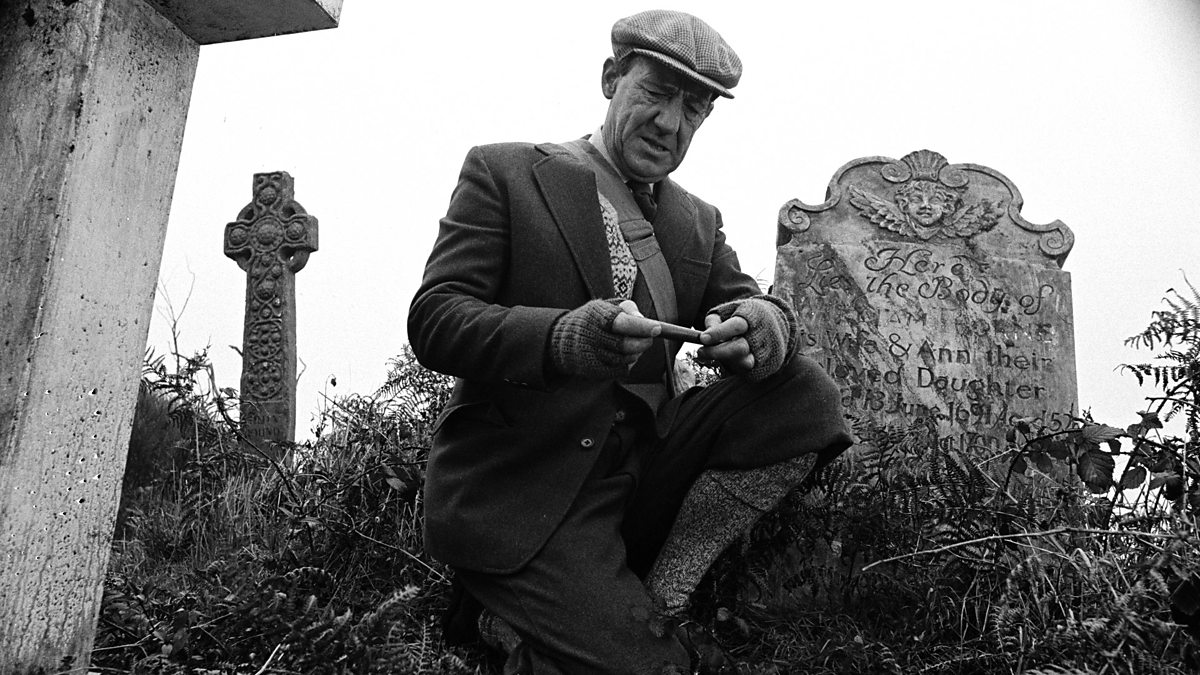
Whistle and I'll Come to You (1968, dir. Jonathan Miller)

Image result for whistle and i'll come to you


Set along the coast of East Anglia, Whistle and I'll Come to You sees Geography and History converge in a way wholly typical of M. R. James. It follows an arrogant Cambridge academic, Professor Parkin (played by Michael Hordern), staying at a guest house who, one day, stumbles upon an old grave. From it, he finds a bone whistle which he decides to keep and, back in his hotel room, he notices that it's inscribed with the words, "Quis est iste qui venit", which translates to, "Who is this who is coming?". After blowing on the whistle, the wind picks up outside and, later that night, he hears noises in his room. Parkin's self-assured, academic rationality is slowly and steadily brought into question as he faces increasingly bizarre occurrences that one wouldn't hesitate to call supernatural.

The film builds to a quiet and unnerving climax which is made all the more powerful for its simplicity. It is an efficient and effective horror masterpiece that is by turns chilling and hilarious, and it is perhaps this latter quality which maintains its status as a classic. Professor Parkin is a brilliant creation, detached from reality by his introvertedness and pompous pretension. He mumbles incoherently like a pot boiling over with useless self-importance, and his pedantically calculated responses seem unaccustomed to physical speech, perhaps rather more suited to being written out on a letter behind a cushy desk. He is a cartoon philistine whom the audience can laugh at as much as they can be frightened with simultaneously. These small details and comical flourishes do more to characterise and entertain than many latter day "non-believer" horror protagonists. Incidentally, a lot of recent horror seems so much engaged in creating a marketable and scary monster that they forget to give their protagonists a personality. With a monster so intangible and seemingly absent from sight, it is Hordern's job to imbue the ghost with a psychological presence and reflect it through his character. And when he finally drops his condescending affectation out of sheer terror, one can only be convinced of a supernatural presence.

This psychological reflection serves as one of three essential ingredients to any good ghost story, with the other two being; place and time. The bleak and windswept Norfolk coast, punctuated by the eternal roll of the waves and a watchful but apathetic sun, encapsulates these other ingredients perfectly. A grave, overgrown with vines and hidden away, evokes a sense of temporality, of life returned to the Earth, whispering from a forgotten corner of the landscape. Parkin, the mortal intruder, disturbs this natural balance and pays the price for it. But one can only be sufficiently moved by this paranormal threat if they invest themselves enough in the setting. The place-time continuum is one that has the effect of dwarfing the individual and his ability to reason. They become overshadowed by not just the scars and memory of a shifting and eternal landscape, but their innermost thoughts and feelings, a primal instinct which is much greater than them. Ghost stories are about our involuntary animal reaction to a place, anthropomorphising it with a malevolent and omnipotent agency. The idea of a "ghost" draws on the inexplicable and concentrates it into a mysterious phantom Other who always has a greater claim to place than the mortal individual. Where the individual has conscious knowledge, the ghost has unconscious knowing.

The geographical focus of a ghost, though, cannot be attributed to a nation. Rather, a ghost belongs to a locality. Folklore and myth precede the existence of nations, and are created from the act of dwelling. Ghosts are particular to a house or village, tangible places. The nation, on the other hand, is abstract. The only way in which one can have a discussion about the ghosts of different nations is simply to find patterns in their geographies. America has a lot of wide open flat spaces, deserts, mountains, old sacred grounds and new developments, and therefore the type of ghost which occurs will correspond to these features of landscape. The English, on the hand, have a landscape filled with history, green rolling hills, curving roads, ancient villages and towns, ruins. Both nations have their own civil wars to draw from (historical violence and struggle always makes a good ghost). Britain has the ghosts of Empire, the US has the ghosts of the slave-owning south. But only in these patterns can we associate the paranormal with a nation. Culture exists first and foremost on a regional scale, and the folklore of, say, Yorkshire, would differ greatly from that of Somerset. One has to take into account the socio-economic aspects of an area, how populous it is, its language and colloquialisms, its own particular history, to get a true understanding of the ghosts one can find there.

I'm currently reading George Monbiot's Feral (2016), in which there's a chapter about how the drastic spike in big-cat sightings is a collective psychological response to our need to re-wild ourselves, attributing it to a much older phenomenon, "Certain paranormal phenomena afflict every society, and these phenomena appear to reflect our desires; desires of which we may not be fully conscious." He notes how Victorians saw more ghosts because of their higher mortality rates. This is analogous to my own ideas, of the ghost as a romantic response to the place-time continuum. Their attachment to the land could be seen as inherently conservative, but in the impermanence of things they could also be simply distant memories. There isn't a simple answer to what a ghost represents; they are that which is beyond reason, as we see in Whistle and I'll Come to You. This is more the case than in Poltergeist and Paranormal Activity, which essentially rationalise the ghosts into being. There could be any number of reasons for this, be it; historical, religious, cultural or geographical. Typically, the English ghost story stops where the comprehension starts.


Wednesday, 22 February 2017

A Spell to Ward Off the Darkness review

Reflections from a Young Movie-Goer


 Less a documentary and more a visual essay, A Spell to Ward Off the Darkness (2013) is a collaboration between Ben Russell and Ben Rivers. It follows musician and artist Robert Aiki Aubrey Lowe through three separate locations; a commune in Estonia, a forest in Finland and a black metal gig in Norway. This is perhaps all there is to say on the plot. All three segments have their own distinct style of film-making. The commune is observational, capturing conversations both inane and philosophical (and often both). For instance, there is a discussion following an orgy in a sauna about whose finger was in whose rectal cavity, and later one woman explains with a child-like innocence the spiritually unifying force of Trance music. The Forest has a meditative, poetic quality to it where the shots cease to resemble any sort of a narrative and sometimes linger for minutes. The black metal performance, in contrast, is claustrophobic and raw. Yet, filmed in only one take that rotates slowly around the band, there's something hypnotic about it that gives the film's very final moments of quiet an immense sense of catharsis.

While all three "spells" feel completely different, not just physically but emotionally, they all have a meditative, isolating and intuitive quality to match their natural settings. More than anything, one is struck by a sense of anarchic alchemy, where each shot feels caught rather than contrived, unique and particular to that moment. The exchanges between commune-dwellers. The incredibly long take of Robert rowing out into a lake, watching a log cabin burn. The unflinching endurance of the last segment. There is a rawness and honesty in this technique, which similarly evokes this lurking darkness within and without. Place and person form a kind of duality, at times part of one another, and both permeated by the darkness that accompanies a brooding loneliness. And each mortal moment evokes a sense of temporality and eternity, one is left to answer how each "spell" brings value to an otherwise meaningless life.

At first one could mistake it for a music video from some obscure, hipstery post-metal band. The pretensions of those earlier conversations, the aestheticism of the forest and the brutality of the black metal performance are easy to pass off as style over substance. But if one can get past those initial irritants, there's a more profound, resonant purpose to their inclusion that lurks just beneath the surface.


Sunday, 12 February 2017

Commodified Spirituality and Minimalism: A Documentary about the Important Things

 Reflections from a Young Movie-Goer


Documentaries, more so than other films, are perfect manipulators of reality. Their direct intersection with real life bears a resemblance to news reports or advertisements, all three have to convince their audience of this version of events, in the hopes they might act upon the given information. But unlike these other two forms of media, Documentaries have a filmic scale that gives one the opportunity to become more fully immersed in the worlds that they present. One expects some complexity from this, if not less bias, so that their worlds (and arguments) become more convincing. In most cases, Documentaries that do cherry-pick the features of their worlds are overtly political, think Winter on Fire: Ukraine's Fight for Freedom  (2015) or the work of Michael Moore. In these instances, the films are excusable for all their flaws or tipexed-out bits because their rhetoric has a more direct urgency to our own world. But for Minimalism: A Documentary about the Important Things (2016), in the absence of complexity or political gravity, we have, instead, an overlong advertisement.

It opens by bombarding audience with wobbly Cloverfield-esque footage of black friday, people with PhDs telling us how consumerist we've become, and a timelapse of a gigantic Best Buy, punctuated by a neon-lit permanence, getting swarmed by a Malthusian mass of meaningless, existential people-blurs. Then, from this philistine, soulless world two trendy prophets arise with the answer. Like all good entrepreneurs they have a back story (which shows emotional involvement); they were living inauthentically and were unsatisfied with their corporate existences. But then they found the light, a cure which they could communicate to the masses; minimalism. The doctrine of minimalism is to renounce mass-consumerism, and live with only the things which add value to your life. They are the popes of this movement, giving themselves the snappy moniker of "the Minimalists", and they've happened to write a book about it which you can buy. They're nice guys who travel across America giving talks and don't care if there's only two in the audience because they've still been able to "spread the word". They're insistent that you know they prefer hugging over handshakes. And they want you to buy their book. But wait, you ask yourself, surely it can't work if you have a wife and kids. Think again, they say, this guy has a wife and kids and still does minimalism. But wait, it can't actually improve your mental and physical wellbeing, can it? Think again! This woman has a debilitating condition, but when she applied minimalism, it cleared it up instantly! But wait, these guys are just in it for the money, right? Wrong! This guy's mum died of cancer, and he's on his own sort of spiritual journey to appease her vengeful spirit. This is the extent of the documentary, it's an advert.

It surrenders any factual coherence in favour of a weak plot that follows "the Minimalists" on their tour, stuffed with little touches of characterisation that attempt to prove their humanity, that they care deeply about your wellbeing. They act like a checklist for the successful business types of the 21st century; laid back, casual but trendy clothes, inspiring talks, making friendliness a part of their brand, trying to instil their product with humanitarian purpose. It's almost laughable how many times they're shown telling people that they're "huggers" rather than hank-shakers, shoehorning it into their brand appeal. It's made worse by the fact that there's a lot to salvage from their message, perhaps a much more noble documentary which takes a journalistic approach to the topic. It plays into the whole phenomenon of commodified spirituality, alongside the likes of mindfulness and yoga, which present themselves as icky trends for Middle Class consumption that put off outsiders with their cultish, dogmatic presence. The same can be said for environmentalism and healthy eating, whilst their branding makes them easier to consume amongst those who can, they remain shallow, overbearing and unaffordable to those who can't. And rather than showing minimalism as a political, collective activity, it's sold directly to the individual under a guise of political effectiveness. This faux-politics becomes glaringly obvious at one of their talks, where a homeless-looking-black-man in the audience spouts some sort of anti-establishment people power wisdom, an ugly Hollywood stereotype laden with racism, and to this the two minimalists, with a businessman-like cunning, agree and swiftly assimilate it to their cause, without developing the point any further.

The problem is that this is an exploitative mode of Documentary-making, because it poses its anti-consumerist message in the form of a consumable. It highlights a tendency towards virtue signalling in America, something tied up with a perverted cross-breed of Capitalism and Religion, where badges-of-goodness are more important than rational thought. This is why we need complexity in Documentary making, so that it avoids dogmatising its subject matter. Even if the result is still largely one sided, the audience can be shown rather than told. Minimalism fails to reach any substantial layer of complexity or factual exploration which leaves it a shallow advertisement, too easy to step in and scatter into nothingness.


Wednesday, 8 February 2017

Better than Inception; Paprika and Cinema's relationship with Dreams

Reflections from a Young Movie-Goer


Dreams are an obsession of cinema. The two are interwoven through their artifice and intangibility, creating and recreating spaces that range from familiar to foreign, abstract to uncanny. It's a relationship as old as the medium itself, evident right from the beginning in many of George Méliès phantasmagoric visions, tapping into a Gothic sensibility which revelled in the dark side of the human psyche. It can be traced through the whole of cinematic history; Un Chien Andalou, The Wizard of Oz, Meshes of the Afternoon, the works of Tarkovsky and then David Lynch. If not directly about dreams, these works at least move and behave like dreams. With Christopher Nolan's Inception (2010), dreams became a window into character psychology as well as an excuse to do cool CGI things. But for all its cinematic splendour and wow-factor Inception lacked something its predecessors excelled at; poetry. Satoshi Kon's Paprika (2006) triumphs in comparison by doing that which Inception didn't, and avoiding some of the things it did.

The film is set in a near future where a recent invention called the “DC-mini” allows Psychotherapists to enter their patients' dreams. Following its theft, the team in charge of the device, including a Doctor Atsuko Chiba and her alter-ego Paprika, attempt to track it down. Cue rabbit hole; dreams enter reality, reality enters dreams. The line between the two grows increasingly obscure in a way that serves a deeper, more profound purpose. Bringing online spaces and the medium of film itself into the mix, Satoshi Kon creates a sense of balance between the internal and the external that feels wholly appropriate to Japanese cinema. It's a nuanced narrative idiosyncrasy that Nolan and the rest of Hollywood sorely lacks, usually placing emphasis on chasing the macguffin rather than pausing to explore the path that it uncovers. Paprika doesn't overstay its welcome, but it manages to ask some interesting questions on the way with delicate flourishes here and there, largely through its Detective character. The times spent in Paprika's website-bar discussing his student film, echoed by his recurring dreams about a homicide case are among the film's most poignant moments. It's a nice touch that we never learn much about the homicide case or get bogged down in useless details surrounding it, as many Thrillers seem to do fetishistically. Furthermore, Paprika's existence is never truly explained which, while perhaps to the chagrin of many, keeps the film neat yet open-ended. This, combined with an attention to the geography of dreamscapes, and imagery only anime can conjure up, imbue the film with a unique vision of its own.

The charges it faces of not being quite as thrilling as Inception or quite as fantastical as Spirited Away (2001) miss the point. Paprika doesn't tread a middle ground between these two but creates something completely different. It isn't a Science Fiction Thriller, but closer in tone to the philosophical fantasies of Jorge Luis Borges. It's a film that's easy to overlook for a variety of reasons, even watching it with the wrong expectations might be enough to turn one off of it. It doesn't reach the magnificent heights of some of its immediate neighbours, but it does understand exactly what it wants to be and it achieves it with a modern, introspective quality and an utterly unique style that guarantees it a place in the canon of Poetic-Dream-Films.


Thursday, 26 January 2017

Everybody's Gone to the Rapture, a step in the right direction?


Are Video Games too violent to appeal to a wider audience?


Image result for everybody's gone to the rapture


Let's face it; Video Games have thus far in their short existence been pretty crap at storytelling. Even the most lauded of video game plots are, in the end, simply justifications for shooting and killing things, mcguffins for male-dominated power fantasies and such. It seems like the whole industry has fallen into a rut where they're stuck churning out the same violent game over and over; this one with soldiers, this one with aliens, this one with cowboys, this one with soldiers again. Because of this, there is an understandable snobbery against the medium, the term "Gamer" seems to lack the implicitly sensitive and cultured disposition of the "Reader" or the "Film buff".

One crucial difference between reading and gaming is that gaming is still seen as a hobby rather than an integral part of culture. Everyone reads in one form or another, but games seem to be stuck with the narrow audience of younger kids and older kids. It's a catch 22 for the industry, who assume that kids don't care about innovation or sophisticated storytelling as long as they get to kill something. Killing sells, and companies need a guaranteed return on their investment. Salvation for the medium might come in the form of indie games which are, on average, infinitely more innovative, varied and interesting than triple A games. And a simple mention of Minecraft is enough to evidence their enormous growth in popularity. There are plenty of brilliant indie games out there, many of which tell compelling stories, yet they haven't exactly opened the medium up to non-gamers. This is through no fault of their own, rather more it is a result of their limited media coverage in comparison to larger games, which also happen to make the loudest noise when at the centre of a controversy. As a result, video games can probably seem almost impenetrable to non-gamers, who might only have a passing, vague wariness of the medium and its apparent power to sap juvenile attention spans.

To those people the "walking simulator" would stand at odds with almost everything they know about video games. The name alone gives you a substantial idea of the genre's snailean idiosyncrasies, as well as its divisiveness amongst gamers. Walking simulator is a term indicative of derision as much as innovation, leaving gamers simultaneously baffled, exhilarated, bored, relaxed, awestruck and even annoyed. My own first experiences with the genre were in the form of Dear Esther and Proteus, both of which blew me away. Like the Dark Souls games, they required the player to re-think the way they interact with virtual worlds. The challenge they presented wasn't physical like most games, nor mental, but psychological. To really get the most out of the experience, one had to immerse themselves in the worlds they were presented with, and the narrative they garnered from it was unlike anything they could get from a film or a book. This is where the true innovation of the genre lies, making full use of the medium. By stripping it back to its core elements, player and world, one has to find the story for themselves. Most video games have imitated films when it comes to storytelling, implementing bits of explanatory cutscene between gameplay to give the whole thing a sense of momentum, but for walking simulators, the story was in the gameplay.

Image result for dear esther


I was moved to write about the subject after recently playing Everybody's Gone to the Rapture, The Chinese Room's follow up and spiritual successor to the aforementioned, Dear Esther. As stated above, Dear Esther was my first experience of the genre; the sheer poetry of it completely reinvigorated my understanding of the medium. Yet, the graphical capabilities of the time still left more to be desired from the genre. A key element of the walking simulator is immersion, and coming up against the physical boundaries of the world sometimes burst my bubble of reverie. The Hebredian landscape, though stunning for the time, was never quite realistic enough. I'd be wandering along a bleak, jagged coastal path only to be reminded of its artifice by a pixellated surface, a minor glitch or a sense of irritation at having to plod through less interesting parts of the world. I wondered if non-gamers, who needed to be convinced of the medium's worth, would make those allowances necessary for enjoyment.

With EGTTR, those allowances are completely vanquished. Throughout the several hours I played of it, not once did I feel like I had to compensate for any shortcomings. And not once did I feel like I was trapped in an empty, soulless world, despite it being set in a village which is devoid of all human life. Set during the 1980s in the fictional Yaughton, in Shropshire, the player has to uncover the truth of what has happened to its vanished population. The only thing close to characters are a series of wandering orbs of light that enigmatically move between places. Approaching certain areas will trigger fragmentary pieces of exposition, acted out by ghostly figures composed of light. These scenes are rarely in any sort of chronological order, and the characters are often hard to tell apart. But this is a central part of the game's appeal, the player's hand is never held throughout the entire experience, rather they have to make whatever they can of the elusive plot. And after one play through, I feel like I've barely scratched the surface of Yaughton.

The game manages to evoke simultaneous senses of immensity and compactness, noise and tranquillity, fleeting moments and perpetual existence. The story feels like it extends to every inch of  Yaughton, with wisps of exposition giving the player glimpses of something much bigger than them, reflected in the virtual space. As for the village itself, it is perhaps the most hauntingly beautiful ever conceived in a game. For a place so seemingly devoid of life, it's never quiet. The wind whistles, the trees sway and whisper, birds sing in the distance. Clouds pass in front of the sun, dimming and brightening the world. A delicate, mysterious haze punctuated by points of light hang around specific places. It gives a vision of a bucolic apocalypse, one at once both idyllic and eerie. Such a complex set of feelings wrought from seemingly so little is what catapults EGTTR beyond Dear Esther. The player is constantly moving towards some sort of conclusion, but it never feels like the conclusion is the actual goal, rather more it is about being able to exist in the world, and as such the more you put into it the more you get out. This is helped by superb voice acting and an awe-inspiring score that shifts from Vaughn Williams-esque orchestral to ambient and to choral. Unlike Dear Esther, the player can carve their own route through the village, making every second of play time feel unique. Discoveries made feel personal, the ambiguity of the world and the story leaves plenty of room for interpretation and revelation.

This is a type of storytelling wholly unique to the medium, and it is achieved with a nuance and delicacy unseen in other games which often slip into caricature and crass, comic-book sensibility. Those who have derided the game as pretentious and boring have simply not understood the challenge it presents. Like the film making of Andrei Tarkovsky or the music of Brian Eno, it demands something of its audience, and in return they can enter into a dialogue much more profound, meditative and insightful than at first expected. The world and the story seem one and the same, resulting in a powerful atmosphere which draws attention to the continuities of time and place. As the player moves through it, they realise they are only another element of it, both affecting and affected by it.

This type of game is a million miles away from the linear, quick-hit-dopamine dependency of other games. EGTTR's quaint, chocolate box setting and at times almost Archers-esque dialogue are completely different to the usual rotation of video game environments. With all these elements in mind, I can completely envision it opening up the medium to non-gamers. It just about slays every pre-conceived notion I had about video games, and perhaps might do for the uninitiated. The game's critics should consider whether it's a game that's even meant for them, they all seem to be too concerned with the lack of a "sprint button" so they can get the thing over with.


Friday, 11 November 2016

The Valerian trailer, French comics and why I dislike Zack Snyder

Reflections from a Young Movie-Goer


The follow up part of Supernatural International will be up shortly. It's become quite a research project now, demanding much more scrutiny than I'd originally planned. The next part will be looking at 60s British ghost films, Whistle and I'll Come to You (1968) and The Innocents (1961), but I also have plans to look at J-horror, haunted houses, a couple of really interesting Asian films from this year called The Wailing (2016) and Under the Shadow (2016), a few short stories, and maybe even a comparison of the two different versions of The Woman in Black. Once I started looking around, I found out there was a lot more out there than I had first anticipated. The subject matter is hugely interesting though as it seems to transcend the horror genre altogether. To merely associate ghosts with fear is to neglect how broad their cultural influence is and, furthermore, how they feed into our other emotions. Their very existence in our imaginations (both individual and collective) highlights the sheer poetry of our ability to interpret reality; how we interact as emotional, irrational beings with our surroundings, with others and with time.

In the meantime though, before I get carried away, I've been intending to write a post about the state of Science Fiction. I'd drafted a couple of posts about it but never finished them and, up until today, had since forgotten about it. However, after watching the trailer for Luc Besson's new film Valerian and the City of a Thousand Planets (2017), I thought now would be the perfect time to revive the topic, seeing as what I'd written then aligned perfectly with my reasons for getting excited about the film. For those that haven't already, you can watch the trailer here. Valerian looks like it will closely echo the stylings of Besson's previous film, The Fifth Element (1997), presenting a lush, distant future filled with colourful aliens, robots, spaceships and all the other staples of a space opera. It's based on the French comic, Valérian and Laureline, written by Pierre Christin and illustrated by Jean-Claude Mézières, first published in 1967. The trailer shows us little plot-wise, hopping from one richly detailed panorama to the next as The Beatle's Because plays in the background. The song is a brilliant choice, telling us that this won't be the gritty, self-righteous Sci-Fi we've become accustomed to, but rather be closer in spirit to the French comics scene on which the film draws from.


I think that a lot of US Sci-Fi must labour under the impression that it is impossible to be intelligent and have fun at the same time. Either that, or they just don't know how to. This could perhaps be because of their national obsession with good and evil narratives, and their taking stories way too seriously. The most obvious example of this is the work of Zack Snyder and, more specifically, the way he crudely shoehorns subtext into his version of Superman. All the humour in his work, rather than being neatly woven into the story, is a separate thing altogether, as if it were carelessly sprinkled on top of the plot. Although you can't blame him entirely for exploring the serious side of Superman, as morality forms the basis of the Man of Steel myth. Yet Snyder went completely wrong in trying to make Superman dark and gritty, pulling crass Jesus poses here and there, and frowning in the rain. My own favourite renditions of Superman have been ones which have room for humour and real ideas, like Grant Morrison and Frank Quitely's All Star Superman. Stylistically, All Star Superman is a lot closer to the French Sci-Fi comics of the 60s, because Morrison and Quitely know how to wield creativity to effective, meaningful ends. I think this difference between comic and film can be observed throughout many recent Super-outings, with films turning down comic-book outrageousness (weirdness, silliness, campness) in an attempt to be taken seriously. Another case in point; the X-Men. In truth, no amount of black leather and chrome will make these characters more serious and grown up, they're crime fighting mutants, one of them shoots lasers out of his eyes.


The overwhelming popularity of the Marvel films has to some extent infected the comics too, which are now simply spandex-clad soap operas. Ultimately, they pale in comparison to something like Métal hurlant, an “adult-oriented” French comic magazine that began in 1974. French comics can openly admit when they're smut, and they don't try and dress it up in sensible clothes or infuse lessons into their readers. They let the imagination roam free, providing an intoxicating, morally apathetic sense of escapism, and as a result feel a lot closer to Art than Entertainment. This is apparent in Alejandro Jodorowsky and Moebius' The Incal, whose fruitful panels are filled with copious amounts of colour, character and interest. For Moebius, the meaning of the comic is in the art itself, it echoes the Decadent movement providing us with art for art's sake. Like the Obelisk and Olympia press who between them published Ulysses, The Tropic of Cancer and Naked Lunch, art and pornography become to some extent indistinguishable. The eroticism of Moebius' work, abundant with naked bodies and sexual imagery, coupled with its chemically-suggestive psychedelia, is not just a railing against authority and good taste, but an affirmation of human sensuality. With this comes a sort of humour in the very absurdity of his fantastical creations, it is in the sheer conception of these things that the reader feels as if they are in communion with another mind, exploring the limits of the imagination.


Whilst a lot of French comics aren't overtly erotic or psychedelic, they carry this tradition with them, with a light humour that resembles the intangibility of imagination. A lot of US Sci-Fi attempts to limit the amount of imaginative stuff in a narrative in order to create a vaster sense of realism in accordance with their subtextual aims. As such, humour is a foreign element which needs to be worked in carefully, balanced correctly so as to not disturb the serious bits. Watching something like Luc Besson's The Fifth Element, one realises how much the humour is woven into its very foundations. It's a film that knows how to have fun, is unconcerned with providing a realistic, moral basis for its plot. A similar sort of approach is apparent in other French directors like Leos Carax, Jean-Pierre Jeunet or Sylvain Chomet, who understand that sincerity doesn't have to get in the way of entertainment, that in fact they can be interdependent. I think that a lot of recent American Sci-Fi films that have attempted to emulate the aestheticism of the French comics, stuff like the Riddick series or Jupiter Ascending (2015), have only failed because they don't understand the depth of their humour. Valerian, with its portly, spear-wielding aliens who don't so much as charge as waddle into battle, seems to be a good sign for Sci-Fi cinema. All the signs seem to be pointing in the right direction that it will be able to recapture the spirit of French comics, which American Sci-Fi sorely lacks at the moment.